|








|
      
     
|
|
LOMO
(Leningrad, Russia)
The Leningrad Optical Mechanical
Association (LOMO) was originally founded in 1914 in Petrograd (now Saint
Petersburg, Russia) as Russian Joint Optical and Mechanical factory to
produce lenses and cameras. The company manufactured its first microscope
in 1934. The designation Leningrad Optical Mechanical Association (LOMO)
was originally assigned to the company in 1962. Among their brands,
‘Biolam’ refers to biological microscopes, and ‘’Polam’ to polarising
microscopes.
|
|
|
|
|
|
|
|
|
|
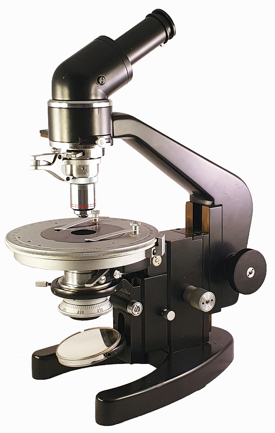
276 (LOMO; microscope мин-10; c. 1965)
|
(150) Micrometre eyepiece LOMO (1980s)
|
|
|
|
|
|

|
Meopta
(Czech Republic)
Meopta traces its roots back to
the year 1933 when Optikotechna company was established in Prerov,
initially producing lenses and condensers. By 1936, Optikotechna
established new facilities to accommodate the rapid expansion of its
operation but was forced to surrender control of its production to the
German army during the Word War II. After the war, the remaining company
was renamed Meopta, an acronym for “Mechanická optická výroba” (mechanical
optical manufacturing). Apart from military deliveries, the company became
one of the world's major manufacturers of cinema projectors between 1947
and 1970. In 1971, production was again refocused primarily on military
products until it was abruptly ended in 1989 (at which time the sale of
military products, which represented about 75% of Meopta´s business, was
reduced to zero). In 1991, Meopta completed its first step toward
privatization when it was established as a joint stock company.
|
|
|
|
|
|
|
|
|
|
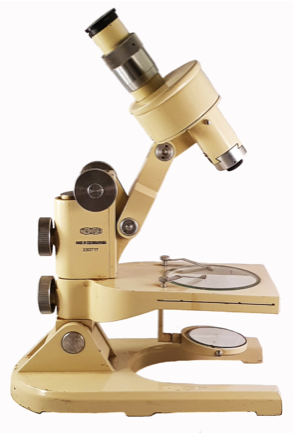
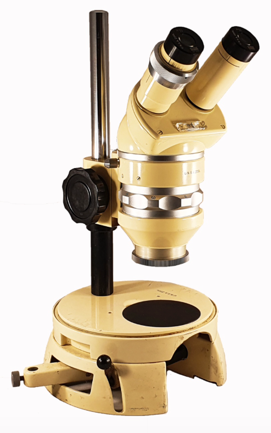
394 (Meopta; stereoscopic microscope; early 1950s)*
|
|
|
|
|
* Instrument kindly donated by Dave Levell
(Pembrokeshire, Wales) in May 2023
|
|

|
Nikon
(Tokyo, Japan)
Nikon was established in 1917 when
three Japanese optical manufacturers merged to form a company known as
Nippon Kogaku KK ('Japan Optics'), producing precision optical glass. Nikon
headquarters at the time was within Tokyo Keiki at 120 Haramachi,
Koishikawa-ku, Tokyo (Hakusan 4 chome, Bunkyo-ku today). In 1925, Nikon
expanded to produce the first microscope with a revolving nosepiece and
interchangeable objectives (the Joico microscope). The trademark JOICO was
from the initials of Japan Optical Industry Co., a translation of Nippon
Kogaku K. K., the company's name at the time. In 1945, with the end of
World War II, production shifts to cameras, microscopes, binoculars,
surveying instruments, measuring instruments and ophthalmic lenses. In
1946, the Nikon brand name was adopted for small-sized cameras.
|
|
|
|
|
|
|
|
|
|
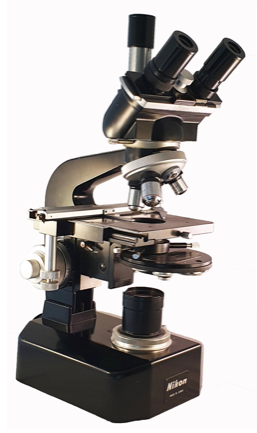
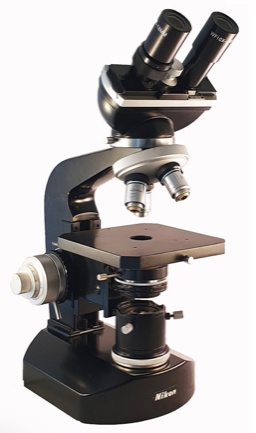
361 (Nikon; microscope series S; 1970s)*
|
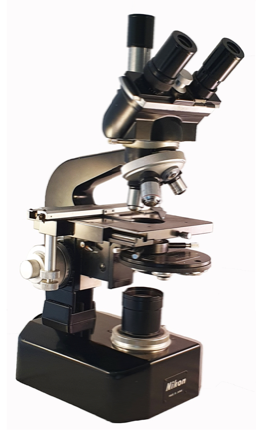
362 (Nikon;
microscope model L-Ke; 1970s)*
|
|
|
|
* Instrument
kindly donated by Dave Levell (Pembrokeshire, Wales) in May 2023
|
|

|
Olympus
(Japan)
Olympus was founded in Japan, in
1919, by Takeshi Yamashita and Shintaro Terada. The name of the company at
that time was Takachiho Seisakusho. The trademark Olympus was registered in
1921. In 1942, the company was renamed Takachiho Optical Co. Ltd. After the
World War II, in 1949, the company became Olympus Optical Co. Ltd. In 2003,
they were again renamed to Olympus Corporation.
|
|
|
|
|
|
|
|
|
|
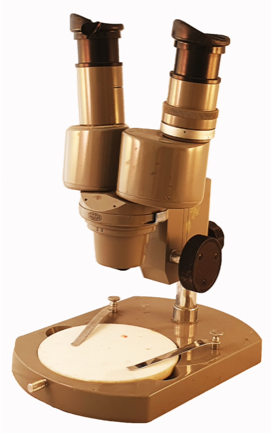
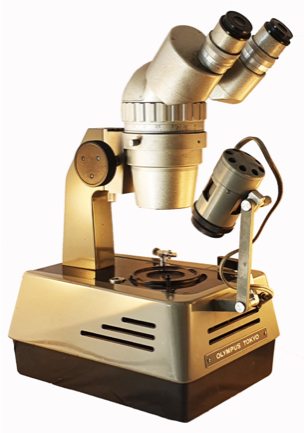
424 (Olympus; stereoscopic microscope, model VA-II; c.
1970)*
|
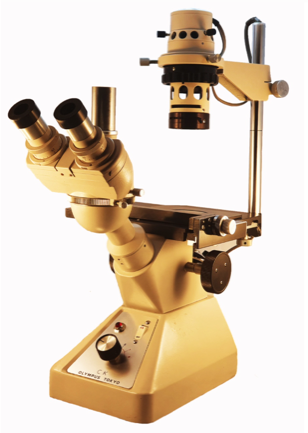
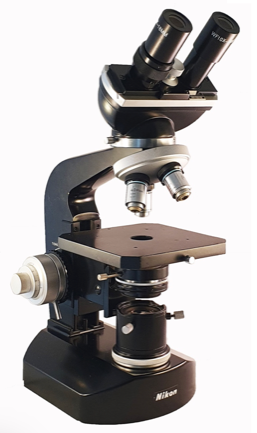
539 (Olympus;
CK inverted microscope; c. 1970)
|
498 (Olympus; stereoscopic
microscope, model JM; c. 1970)
|
603 (Olympus;
CK2 inverted microscope; 1980s)
|
|
* Instrument
kindly donated by Dave Levell (Pembrokeshire, Wales) in May 2023
|
|

|
Wild
(Heerbrugg, Switzerland)
Wild had its origins in 1921, when
three Swiss men (Heinrich Wild, Jacob Schmidheiny, and Robert Helbling)
founded the company Heinrich Wild, Werkstätte für Feinmechanik und Optik in
Heerbrugg. The first major product was the Theodolite Wild T2. In the early
1930s, Wild left the company and moved to Zurich. His old firm became Wild
Heerbrugg in 1937. In 1987, the company merged with the optical firm Ernst
Leitz GmbH of Wetzlar and was renamed Wild-Leitz AG in 1989. In 1990, the
company became part of the Leica holding company. From 1996, Leica was
divided gradually again into smaller units. Leica Camera AG was developed
in 1996, Leica Geosystems AG in 1997, and Leica Microsystems AG in 1998.
|
|
|
|
|
|
|
|
|
|
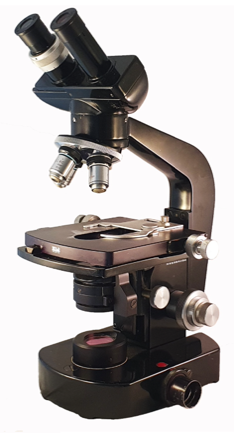
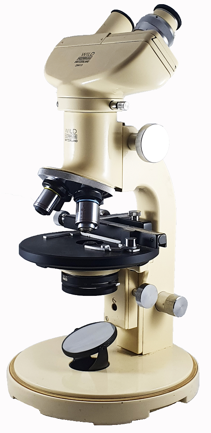
398 (Wild Heerbrugg; microscope M20; 1960s)*
|
463 (Wild
Heerbrugg; microscope M11; 1960s)
|
476 (Wild
Heerbrugg; stereoscopic microscope M5; 1960s)
|
|
|
* Instrument
kindly donated by Dave Levell (Pembrokeshire, Wales) in May 2023
|
|

