

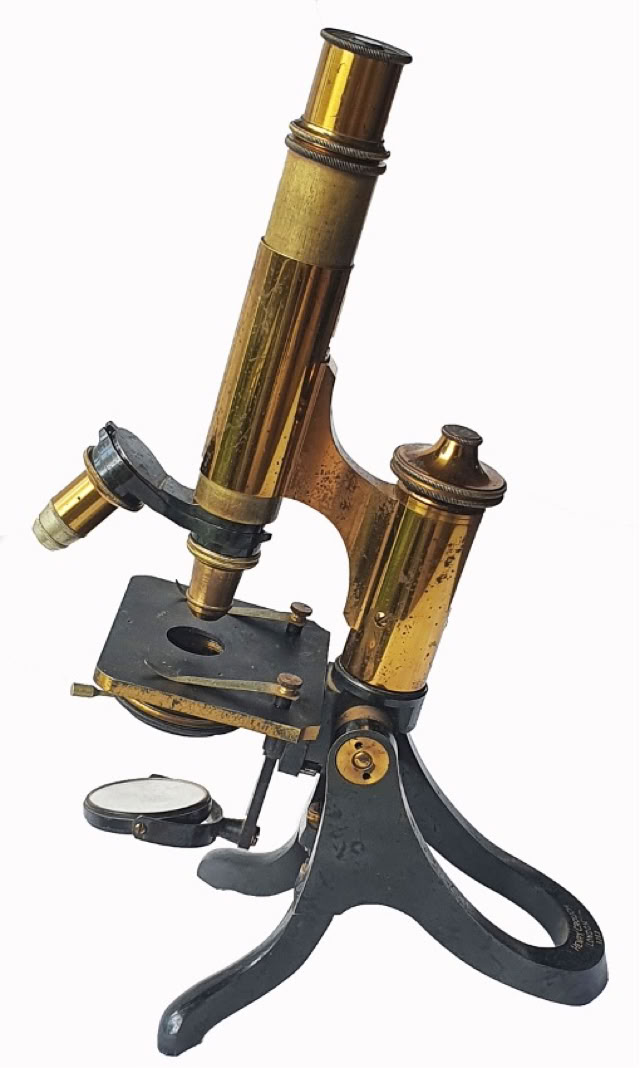
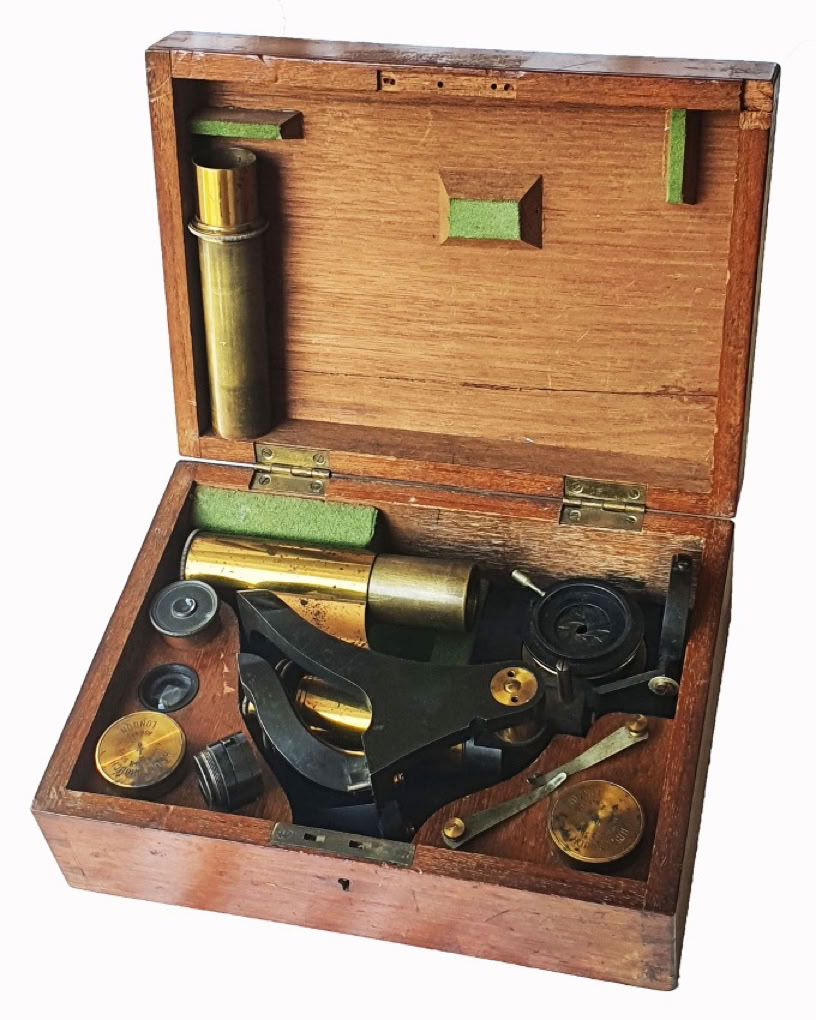
Microscope 516
(Henry Crouch; portable histological microscope, c. 1900)
Henry Crouch trained as an apprentice with Smith, Beck & Beck before leaving the firm to establish his own business, probably in early 1862. His younger brother, William, joined him, and the business initially operated under the name H. & W. Crouch from premises in Commercial Road, London. The earliest instruments produced by the brothers bear this address. Initially, they manufactured microscopes based on designs that Henry had previously worked on during his employment with Smith, Beck & Beck. However, the brothers soon concentrated on producing good-quality, relatively inexpensive instruments aimed at the growing market of middle-class amateur microscopists and students. Henry Crouch joined the Royal Microscopical Society in 1863 and the Quekett Microscopical Club in 1866, reflecting his involvement in the contemporary microscopical community. Advertisements dating from September 1864 indicate that the business had moved its retail premises to 64A Bishopsgate Street, although the Commercial Road address continued to be used as a manufacturing site for several years. The partnership between the brothers was dissolved in 1866, with Henry retaining the optical business. Henry Crouch subsequently relocated his business to London Wall around 1868 and then to Barbican in early 1873. Around 1886, the firm was incorporated as Henry Crouch Limited. In 1907, Henry sold the business to S. Maw, Son & Sons, but remained with the company, supervising the manufacture of microscopes and other instruments. Following the acquisition, many existing Crouch microscopes were additionally stamped with the name of the new owners, while newly manufactured instruments carried the inscription 'S. Maw, Son & Sons' on their feet. During the early twentieth century, Henry Crouch also began producing microscopes incorporating horseshoe-shaped, Continental-style bases. He died in 1916.
Microscope 516 is signed 'Henry Crouch, London' and bears the serial number 9263, suggesting a date of manufacture around 1900. It belongs to the period when Crouch was producing portable and relatively compact instruments. An earlier version of the company's Portable Histological Microscope was described in the 1883 edition of the Journal of the Royal Microscopical Society (Figure 1). The instrument was designed to '… provide a microscope which shall combine portability with more steadiness than is usually found in portable forms'. The journal further described its distinctive construction: '… The stage is made to turn laterally at right angles to the normal position, so as to be in a line parallel with the body-tube, which permits the latter to be reversed and inserted at the lower end of the socket; and the two front feet of the tripod are made to fold outwards and backwards under the heel'. These design features allowed the microscope to be compactly folded for transport while retaining sufficient stability for practical histological examination. The rotating stage and reversible body tube also provided flexibility in the instrument's configuration, illustrating Crouch's efforts to combine portability with functional versatility.

Figure 1. Crouch’s portable histological microscope as described in the 1883 edition of the Journal of the Royal Microscopical Society.