


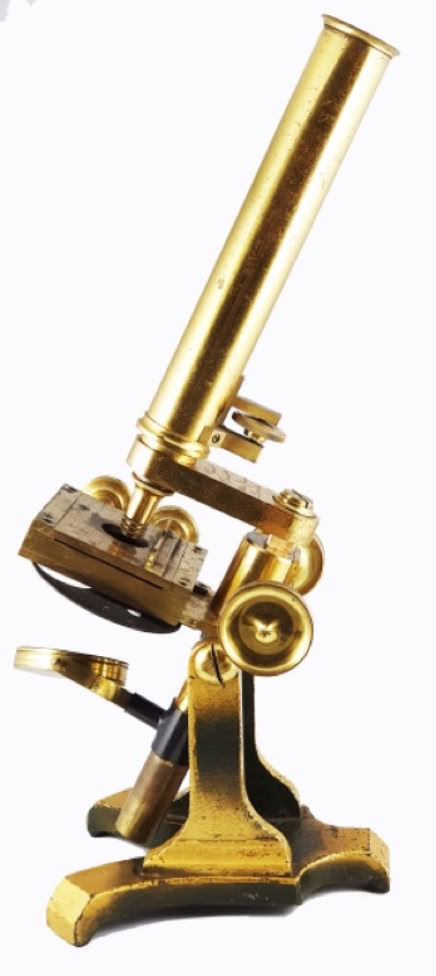
Microscope 51
(Negretti & Zambra; monocular achromatic microscope; c. 1860)
Negretti & Zambra was founded in 1850 by Henry Negretti (Enrico Angelo Ludovico Negretti, 1818–1879), born in Italy, and Joseph Warren Zambra (1822–1897), born in Essex. The firm operated until the late twentieth century, manufacturing scientific and optical instruments and running a photographic studio in London. It eventually received prestigious appointments as opticians and scientific instrument makers to Queen Victoria, Prince Albert and King Edward VII, as well as to the Royal Observatory and the British Admiralty. In 1859, the company published an extensive catalogue listing more than 2,000 items and instruments, including microscopes; the range had doubled within a few years. That same year, the firm moved to larger premises at 1 Hatton Garden. It relocated to 103 Hatton Garden in 1867 and expanded to further premises at 38 Holborn Viaduct, Cornhill and Regent Street in 1869. Henry Negretti also became a prominent figure in London's Italian community. In 1888, Joseph Warren Zambra retired, and M. W. Zambra joined his brother J. C. Zambra and H. P. J. Negretti in the partnership. The company's 1908 catalogue included a wide range of instruments, among them binoculars and microscopes. During the First World War (1914–1918), the firm undertook substantial work for the Ministry of Munitions and developed several innovations, including early aviation instruments. By 1947, it was listed as a manufacturer of industrial, aeronautical and meteorological instruments, and in 1948 it became a limited company. In 1985, the business was acquired by Meggitt Holdings.
Microscope 51 bears the inscription Negretti & Zambra, 1 Hatton Garden, London, indicating a date of manufacture around 1860. The instrument should be a version of Negretti & Zambra’s monocular achromatic microscope (Figure 1). It is accompanied by its original wooden case, which also contains several accessories: a live box, used to observe small organisms in wet or dry conditions; a brass pair of tweezers; and the base of a bull's-eye condenser, although its lens is missing.
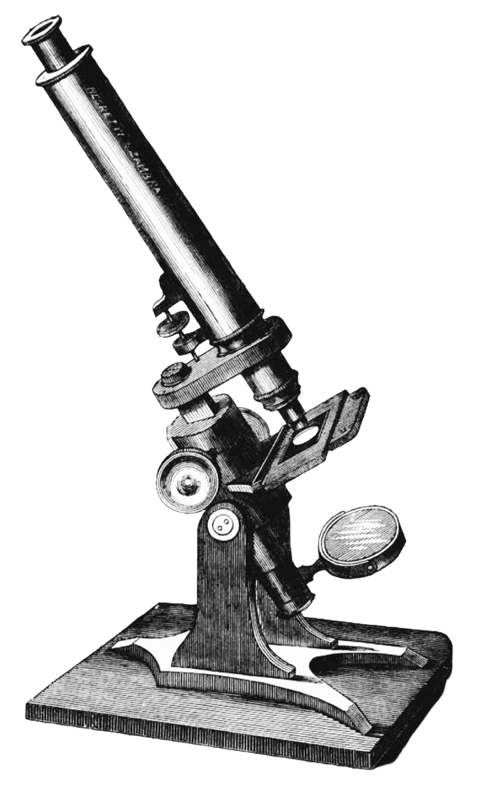
Figure 1. Monocular achromatic microscope as featured in a 1878 catalogue of Negretti & Zambra.