
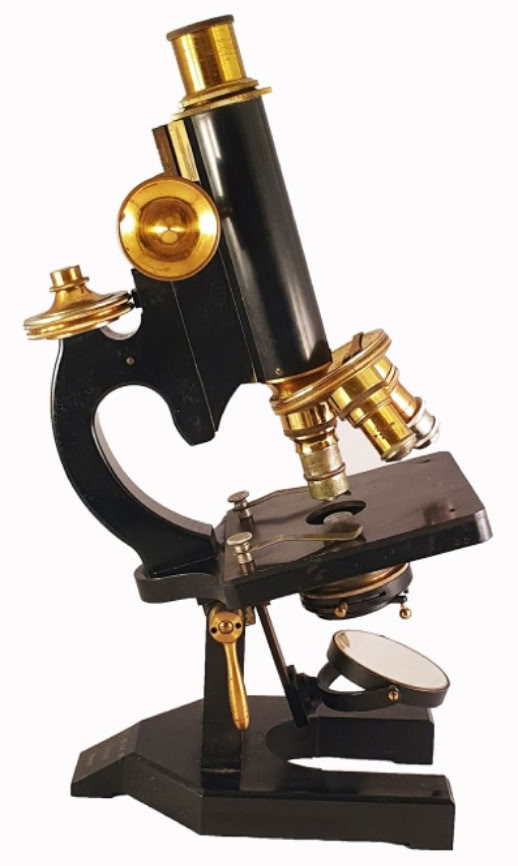


Microscope 328
(R & J Beck; ‘London’ handle model; c. 1913)
R. & J. Beck occupies an especially important place in the history of British microscope manufacturing. The company's origins date to London in 1847, when Richard Beck (1827–1866) entered into partnership with James Smith (1800–1873), an optical instrument maker. Richard's brother, Joseph Beck, subsequently joined the business. Richard and Joseph Beck were nephews of Joseph Jackson Lister, a distinguished British optician and physicist renowned for his work on achromatic lenses and his contributions to the development of the modern optical microscope. In commissioning the manufacture of his improved microscope, Lister collaborated with James Smith, then employed by the instrument-making firm of William Tulley, who was responsible for constructing the microscope stand. Smith established his own optical instrument workshop in 1837. Through Lister's influence, his nephew Richard Beck became an apprentice to Smith in 1843. In 1847, Smith and Richard Beck entered into partnership, establishing Smith & Beck. The company was renamed Smith, Beck and Beck in 1854, following Joseph Beck's entry into the business in 1851. When James Smith retired in 1865, the firm became R. & J. Beck, a name it retained for more than a century. Following Richard Beck's premature death in 1866, aged just 39, Joseph continued to manage the business. In 1895, the company was incorporated as R. & J. Beck Ltd. By 1968, it had become a subsidiary of the American Ealing Corporation. A successor to the original business, Beck Optronic Solutions Ltd, continues the Beck name and its association with optical instrumentation. The company operated from several London addresses: 31 Cornhill (1865–1880), 68 Cornhill (1881–1944) and 69 Mortimer Street (1926–1962).
Microscope 328 is an R. & J. Beck Ltd instrument dating from approximately 1913. It bears the signature 'R. & J. Beck Ltd, London' and serial number 30478. The microscope is known as the 'London' handle model (stand No. 1353) (Figure 1). Its distinctive design incorporates a limb that also serves as a sturdy carrying handle, allowing the instrument to be moved conveniently without disturbing its adjustments.

Figure 1. ‘London’ handle model microscope as engraved in the R&J Beck’s catalogue of 1913.