
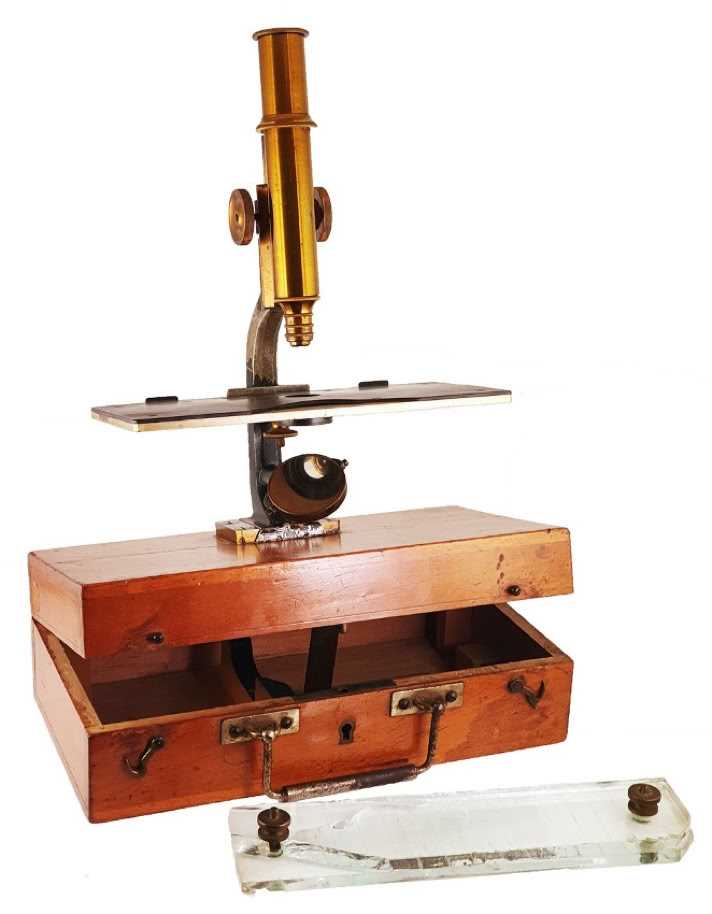
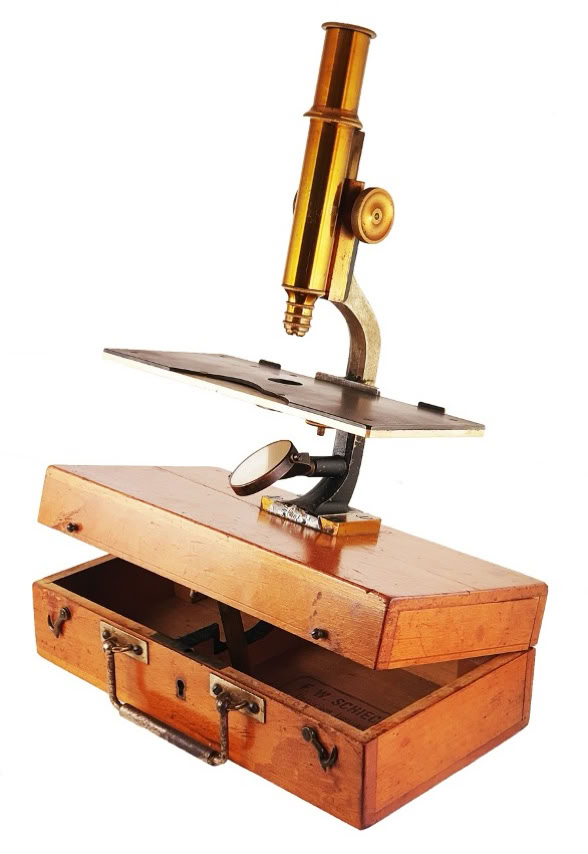
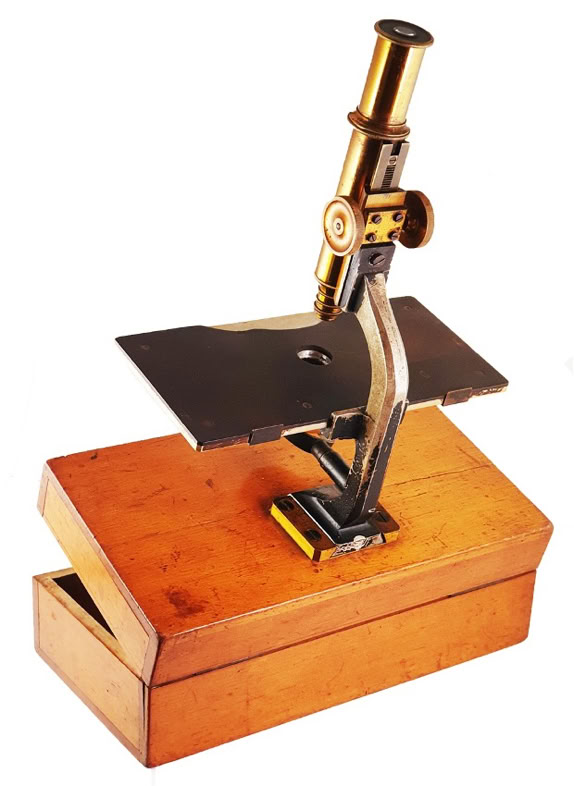
Microscope 30
(F.W. Schieck; portable trichinoscope; c. 1900)
Friedrich Wilhelm Schieck (1790–1870; also spelled Schiek) was the first member of his family to manufacture scientific instruments. After completing an apprenticeship, he moved to Berlin, where he worked with Carl Philipp Heinrich Pistor (1778–1847). By 1824, he had become Pistor’s full partner, and their instruments were signed ‘Pistor & Schiek’. The partnership ended in 1837, after which Schieck began manufacturing instruments independently, with his microscopes generally marked ‘Schiek in Berlin’. Around 1860, Schieck began working with his son, Friedrich Wilhelm Hermann Schieck, who assumed full management of the business by 1865, operating under the name F. W. Schieck Optisches Institut. The elder Schieck died in 1870, while his son died in 1916. The firm nevertheless continued operating well into the 20th century. Under the elder Schieck, the company had specialised in high-quality research microscopes. After his son took over, however, production shifted towards simpler instruments manufactured in greater numbers. Like several other German optical instrument makers of the period, the firm became particularly associated with microscopes for meat inspection, known as trichinoscopes.
Microscope 30 is a portable trichinoscope dating from around 1900. The inside of its wooden case bears the inscription ‘F. W. Schieck, Optisches Institut, Berlin S.W. 46’. The microscope is mounted on top of the case and features an unusually large rectangular stage designed to accommodate a double-plate glass compressorium for examining pork samples. Unfortunately, the compressorium supplied with this instrument is broken.
During meat inspection, thin sections of pork were placed between the glass plates and compressed to produce sufficiently thin, translucent preparations for microscopic examination. Inspectors could then search for the encysted larvae of Trichinella, parasitic nematodes responsible for trichinellosis, in the meat.