

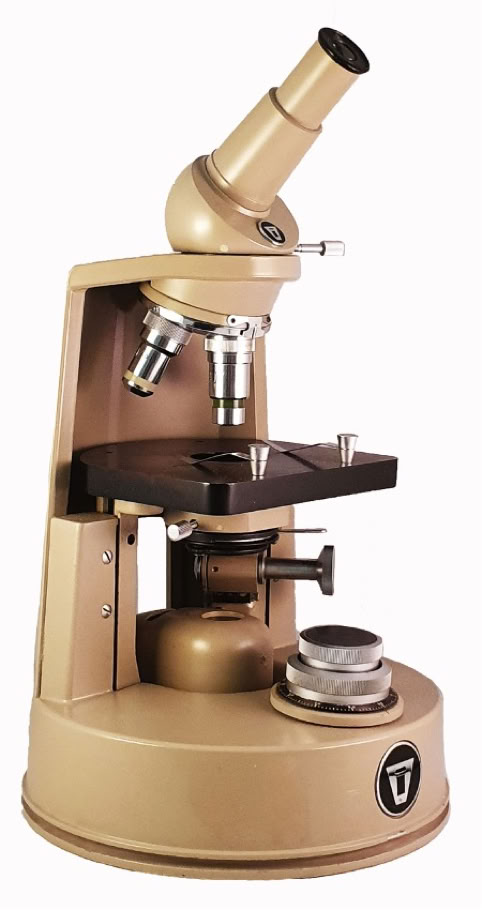


Microscope 117
(Vickers; Patholette II microscope; 1970s)
T. Cooke & Sons was founded by Thomas Cooke in York in 1837 and became a prominent British manufacturer of scientific and optical instruments. In 1855, Thomas Cooke established his own factory at Bishophill, York, where the company produced a wide range of products, including spectacles, telescopes and other optical and scientific equipment. By the turn of the twentieth century, the manufacture of defence-related equipment for the domestic market had also become an important part of the business. In 1915, control of Cooke's was acquired by Vickers Ltd., the engineering and armaments company involved in shipbuilding and aircraft manufacture, which had long been interested in the military applications of Cooke's products. The business continued to expand in York and, in 1922, merged with the long-established London instrument-making firm Troughton & Simms (founded in 1824). The combined company became Cooke, Troughton & Simms, and in 1924 it became a wholly owned subsidiary of Vickers. After the Second World War, microscopes, surveying equipment and precision engineering measuring instruments became among the company's principal products. In 1963, following Vickers' acquisition of the C. Baker Ltd. microscope factory, a new company, Vickers Instruments, was established. It continued to manufacture and market microscopes, surveying instruments and micromeasuring equipment for many years. In 1989, the business was sold to Bio-Rad Micromeasurements, an American company based in California, while the defence-related operations were acquired by British Aerospace.
Microscope 117 is a Vickers Patholette II, dating from the 1970s (Figure 1). Designed for routine laboratory work and educational use, this model was widely used in schools and teaching laboratories. Consequently, numerous examples survive on the second-hand market. The instrument is accompanied by its original purple plastic dome-shaped dust cover, an accessory rarely found today because the covers were prone to breakage.

Figure 1. Vickers Patholette II microscope as featured in a 1968 Townson & Mercer’s catalogue